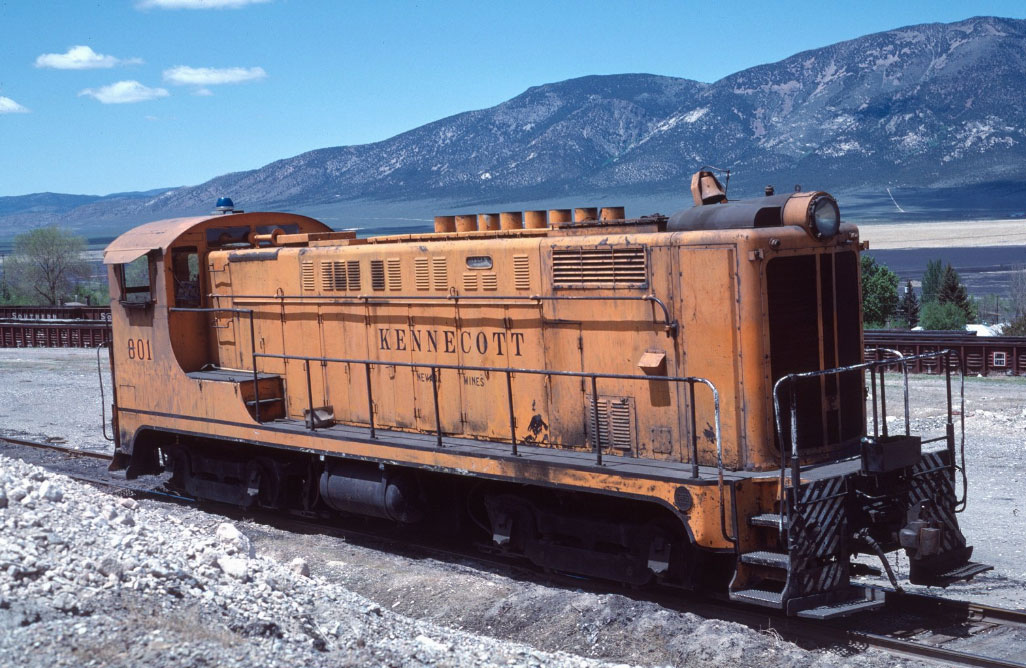
Kennecott Copper Corp #801
Exhibit Code
#801
Description
Baldwin Locomotive Works was founded in 1825, and by 1870 became the premier steam locomotive builder in the United States. Baldwin attempted to make diesel locomotives in the mid 1920’s, but would not try again until 1939 at which point both EMC (forerunner of EMD) and Alco were finding success.
In 1939, Baldwin began producing an end-cab switcher using an engine from De La Vergne. It was a naturally-aspirated straight-8 outputting 1,000 horsepower. Originally, the locomotives were equipped with 4 exhaust stacks, one for each pair of cylinders; however, VO engines experienced back pressure issues with this arrangement, so most were re-equipped with one stack for each cylinder.
Interestingly, Baldwin never called their switcher the VO-1000. The original official designation was 8-DE-1000/1 E, changed in August 1939 to 0-4-4-0 1000/1 E. Railfans coined the term VO-1000 due to its VO engine and its horsepower rating.
#801 was originally purchased for the Bingham & Garfield Railway in 1942. The Bingham & Garfield was built between 1910 and 1911 not only to haul ore between Bingham Canyon Mine and the smelter at Garfield, but handle ore from other mines as well as passengers and goods. By 1922, Utah Copper was handling ore trains with B&G crews.
#801 was the second diesel-electric locomotive purchased for Kennecott’s operations in Utah, the first being Alco S-2 #800 and the third VO-1000 #803. All three switchers were used in the Magna, Utah yard. In 1946, work began on a lower electrified railroad line to haul copper to the Magna mills. On April 30, 1948, the “Low Line” was placed into operation, and the B&G was dissolved.
Kennecott began sending the diesel switchers to other mills, with McGill receiving #803 in 1948. #801 was sent instead to Chino Mines in New Mexico in 1949, where it was renumbered #80. It possibly replaced #800, having likely been sent to Chino in 1944, which was then sent to McGill.
#80 was used to switch the AT&SF interchange at Santa Rita, where the ore cars were assembled into trains for the 9-mile trip over the Santa Fe to the Mill at Hurley. This job lasted until 1963, when number #803 was taken out of service in McGill.
By September 1963, VO-1000 #803 was completely worn out. Machinists in McGill reported that they didn’t have the tools required to overhaul the diesel engine itself. Rather than spend the money required to send the locomotive off for overhaul, Kennecott pulled #803 from service and transferred #80 to Nevada Mines where it was renumbered back to #801.
For almost 20 years, #801 switched the McGill plant, moving cars from the small yard to the mill and smelter facilities and back as well as traveling up the “Adverse” Branch to the Hi-Line to pick up cars of lime for the smelter.
On June 15, 1983, operations at the McGill Smelter ended, with the last Nevada Northern train leaving for Cobre on June 20. With the shutdown, McGill crews began preparing their locomotives for what could be a long wait. #801 had its coolant drained and metal caps fabricated to cap each of its 8 stacks. #801 sat at McGill until October 22, 1993 when it and #802, electric locomotives #80 & #81, 19 ore cars, and one flatcar were pulled out of McGill to be moved to Ely.
In the late 2010’s, one of our volunteers (now a staff member), was curious what it would take to return #801 to operating condition as it was said to be in excellent condition. With the shop’s blessing, evaluations were made, resulting in findings that the locomotive was nearly in operable condition.
After small repairs were made, and new batteries installed, the engine was started for the first time on July 1st, 2022 after 39 years! Following more repairs and adjustments, #801 re-entered service on January 29, 2023.
Historical Archive
You can find more information about this article in our Historical Archive hosted on Luma Imaging.
Specifications
Builder: Baldwin Locomotive Works #78426
Built: December 1942
Type: VO-1000
Horsepower: 1,000
Weight: 236,000 lbs. (118 tons)
Can’t get enough of our Rich History?
If you have any questions or want to request more information for a certain train or equipment, contact us here.