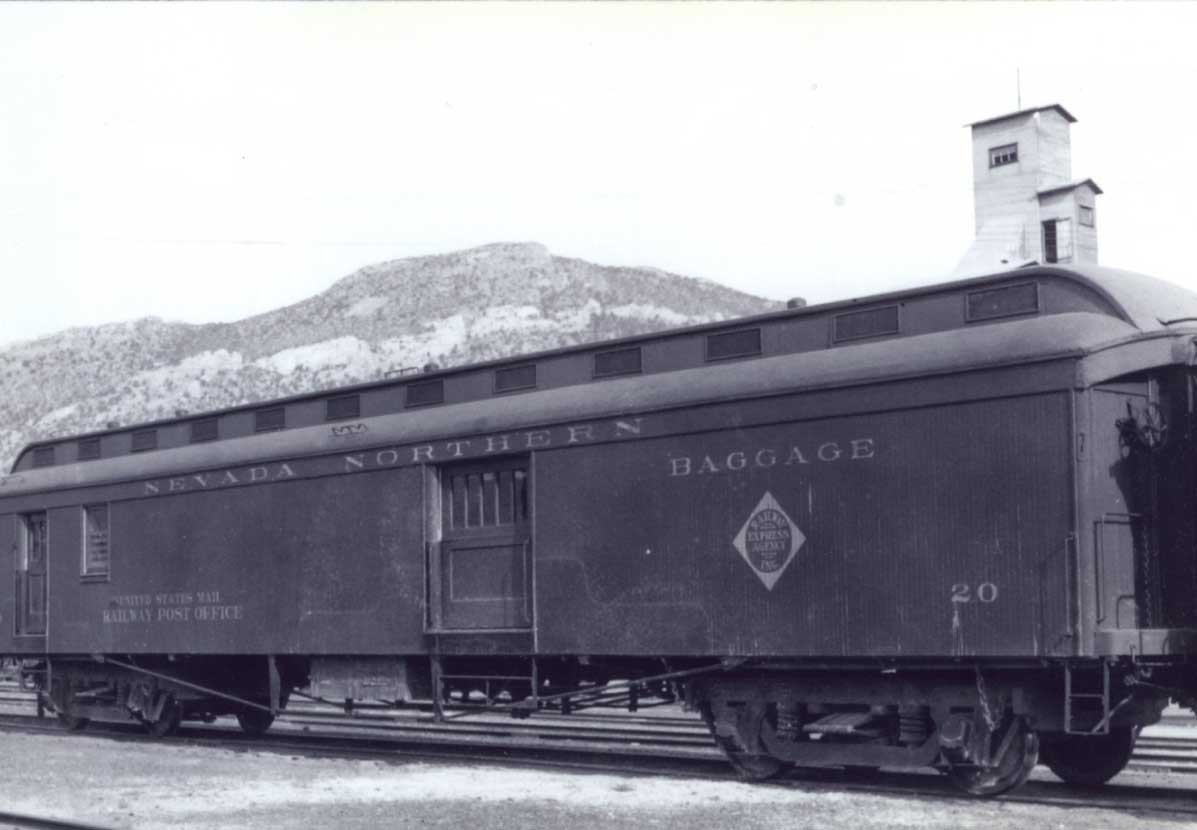
Nevada Northern Baggage/RPO #20
Exhibit Code
#BAGGAGE20
Description
Passenger trains were of vital importance at the beginning of the 20th century. Not only did they move people around the country, but they were the fastest way to move express shipments and the US Mail around as well. As such, most trains carried cars with some sort capacity to move these items.
In May 1907, the Nevada Northern purchased a used baggage car from Harland & Hollingsworth in Wilmington, Delaware, and given the number 20. Despite being built by American Car & Foundry, no builder’s plate or build number exists, so a precise build date or history for #20 before the NN is unknown. It is believed, however, that the car was constructed sometime between 1905-1906.
#20 would also be joined by a new baggage car built by AC&F at the same time, #21. It appears that #21 was delivered with a single baggage door per side, whereas #20 had two per side. Evidence of #20’s former second door is visible inside the baggage compartment.
Their initial use is unknown, but it was likely varied. #21 was used for sure on the Smelter Suburban, but both were likely used on the Main Line Passenger train between Ely and Cobre.
Starting in early 1909, first #21 then #20 were rebuilt by the Nevada Northern to include a Railway Post Office apartment at one end. #20’s was the minimum length at 15 feet, while #21’s was slightly longer at 16ft 9in. In 1912 both cars were equipped with steel underframes and dummy vestibules to comply with new US Mail standards for RPO crash worthiness.
Likely at this time the two cars began to be used primarily on the Main Line Passenger train, with one standing in reserve. Mail Clerks rode aboard the train, sorting mail en route between Ely and Cobre for the communities along the way and in the surround areas. Mail could even be sent from the stations, as mail slots were installed in the sides of the car!
Additionally, the baggage section of the cars not only held passenger’s luggage but carried express shipments as well. Express was any parcel or item, such as perishable goods, needing quick shipping. The Nevada Northern had contracts with at least Wells Fargo & Co (as the cars carried the Wells Fargo Shield) until 1918 when American Railway Express took over all contracts as part of the war effort. ARE was replaced in 1929 when the Railway Express Agency took over.
In the early 1920’s, electric lamps and wiring were installed in the cars to supplement the oil lamps already aboard. In 1928, the Post Office called for minor changes to both cars, however the slightly shorter length of #20’s RPO apartment was already affecting it’s use. In a communication from the Post Office Department in September 1930, it’s mentioned that #20 is “…materially different in storage space…” and was used “…for reserve purposes…” with #21 handling primary duties.
By the late 1930’s, despite the money the mail contract brought in, the Nevada Northern was no longer covering costs running passenger trains. Though replacing trains with self-powered equipment was investigated, the railroad made the ultimate decision to replace rail service with more flexible busses.
Interstate Commerce Commission permission was sought to abandon rail service for the busses, of which the ICC agreed. The State of Nevada, interestingly, required the railroad to hold onto some of their passenger equipment in case the busses broke down. #20 was selected of the two, as #21 was sold to the Virginia & Truckee and left shortly after the final run on July 31, 1941.
In 1956, the Nevada Northern was to celebrate 50 years of the railroad arriving in Ely. As part of the celebrations on September 29, locomotive #40, Baggage/RPO #20, and Coach #5, along with two borrowed Southern Pacific passenger coaches, made trips from the Ely depot to the US-93 overpass and back.
It then became that anytime the railroad ran fan trips or passenger extras #20 joined Coach #5 on these trips. Thanks to a request from the Central Coast Railway Club preceding their 1958 trip, slats were added to the baggage car doorways to allow the car to be used as an open car, a feature it still retains.
When the museum began excursion operations in 1987, #20 was part of the excursion consist as well as Coach #5 and Flat Car #23. Today, #20 comes out for special events and charters, usually paired with Coach #5 to recreate Steptoe Valley Flyer service.
Historical Archive
You can find more information about this article in our Historical Archive hosted on Luma Imaging.
Specifications
Builder: American Car & Foundry
Built: 1905-1906, purchased 1907
Type: Combined Baggage-Railway Post Office
Weight: 86,380 lbs. (43.2 tons)
Can’t get enough of our Rich History?
If you have any questions or want to request more information for a certain train or equipment, contact us here.