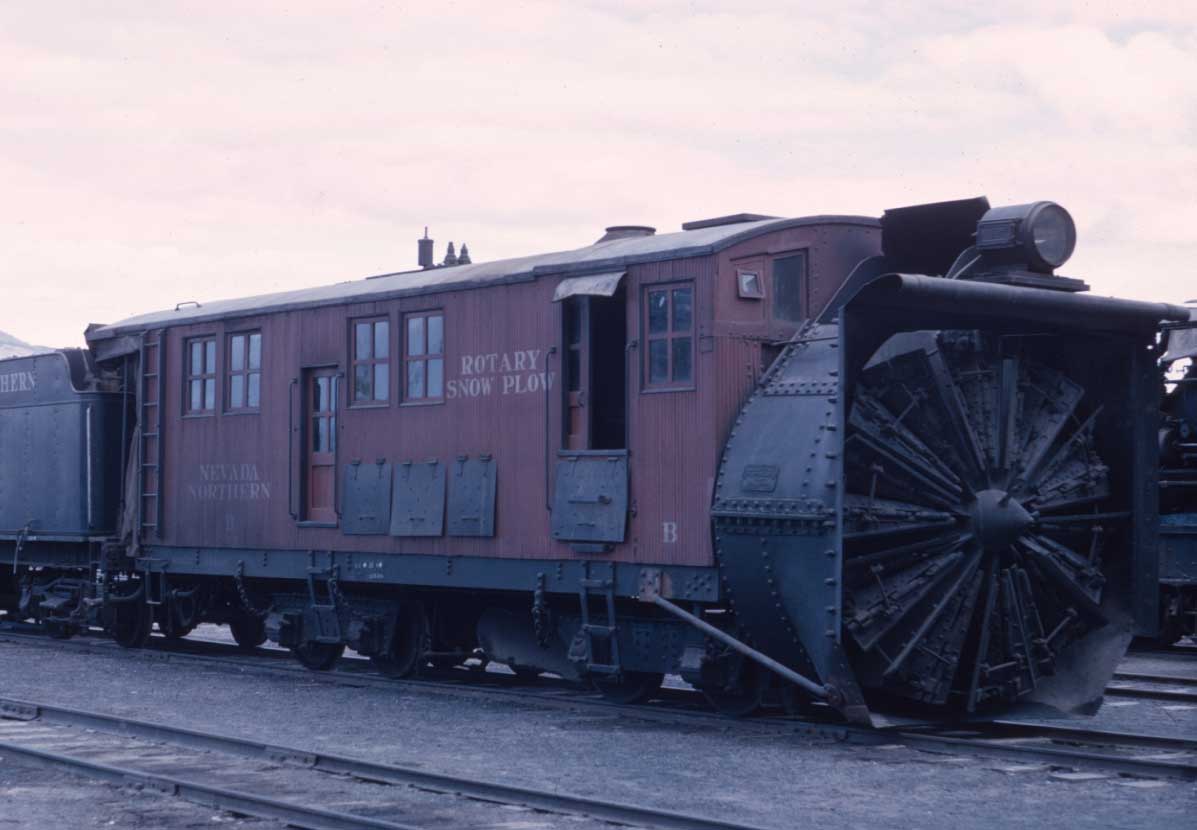
Nevada Northern Rotary Snowplow #B
Exhibit Code
#B
Description
When railroad began, snow clearing was done by pushing a wedge-shaped plow into the snow to push it away from the tracks. If the snow was deep or compacted, men with shovels would have to manually clear away the snow which was very labor intensive. In 1869, Canadian dentist J.W. Elliot of Toronto designed the first example of a rotary plow, though it was never built.
Orange Jull of Ontario improved upon the design and had the Leslie Brothers build a prototype during the winter of 1883-84. It was so successful that the Leslie Brothers purchased the rights and started constructing “Leslie-Type” rotary snowplows from 1885 to 1903. These were often contracted to Cooke Locomotive & Machine Works, which became part of American Locomotive Works in 1900. American gained the full rights from Leslie in 1905.
Rotary Snowplow #B was purchased new by the Nevada Northern Railway in 1907 as part of a rush order. It was completed in November, and received by the Nevada Northern on December 27th. However, it appears that in rush to get the Snowplow completed, certain parts were misapplied or missing, of which American either sent replacements or had the NN bill them for the parts they ordered.
In the summer of 1908, while #B would normally be stored, the decision was made to park the rotary behind the engine house for the purpose of supplying power. At 11pm on June 27th, 1908, the body of the Snowplow caught fire, severely damaging the woodwork rear of the steam dome and breaking 24 windows.
During the repairs to the Rotary following the fire, it was discovered that under the false floor alongside the boiler 30 pounds of wool waste (or what they noted might be the stuffing from a mattress) was packed in. It was believed that the waste caught fire when a spark from the firebox made its way into the waste and slowly ignited.
In 1913, the Nevada Northern was finishing the rebuilding of 2-8-2 tank engine #5 into a conventional 2-8-0. While management investigated purchasing a brand-new tender for the now-renumbered #80, they ultimately decided to remove the tender from #B and give it to #80. The reasoning was that if the Rotary was needed in the winter, a tender could be borrowed from whatever engine was currently in the shop for repairs.
Other than being potentially sold to Alaska in 1909, Rotary #B had a quiet life. Rotary Snowplows are typically a last resort in keeping railroad lines open, and the Nevada Northern was hesitant to use the Rotary. Instead, the railroad would use Jordan Spreaders and locomotive-mounted plows as much as possible.
There were years where the Rotary found itself called to operation. The winter of 1948-49 found so much snow falling that #B was called out to keep the railroad open. That winter was so bad that the Air Force had to drop bales of hay across the Midwest to keep farmer’s livestock alive, later immortalized in the 1950 movie “Operation Haylift.”
In 1952, with the scrapping of steam locomotives beginning on the Nevada Northern, it was decided to retain 4-6-0 #21’s tender for permanent use behind #B. Ironically, #B’s original tender behind #80 was also retained, first as a canteen for Wrecking Crane #A and later as a weed-spraying car!
The Rotary’s last use came in 1969, after which point the Snowplow was pushed behind the Engine House on Track 7. There the Rotary sat for the next several decades before being moved back into the Engine House in the 2000’s. In 2012 the Rotary received a cosmetic restoration, including new wood siding on the fireman’s side.
Currently, Rotary Snowplow #B is inoperable, though the Snowplow is pulled out often in February for the Winter Photoshoots. Long-term plans call for the restoration of the boiler back to operation.
Historical Archive
You can find more information about this article in our Historical Archive hosted on Luma Imaging.
Specifications
Builder: American Locomotive Works – Cooke #44596
Built: November 1907
Type: Rotary Snowplow
Body Type: Steel underframe, Wood body & Siding
Weight: 143,400 lbs. (71.7 tons)
Can’t get enough of our Rich History?
If you have any questions or want to request more information for a certain train or equipment, contact us here.